EU Blue Card Germany: the complete 2026 guide
Germany's premium work permit for qualified professionals. Lower salary thresholds, fast-track permanent residency, and full family reunification rights.
Last updated: May 2026
What is the EU Blue Card?
The EU Blue Card is the most sought-after work permit in Germany. Designed for highly qualified professionals from non-EU countries, it offers significant advantages over a regular work permit: faster permanent residency, unrestricted family reunification, and mobility across the EU.
Since the Skilled Immigration Act reforms (all phases now in effect as of 2026), the Blue Card has become even more accessible. Germany has lowered salary thresholds, expanded the list of shortage occupations, and introduced special provisions for IT specialists without formal degrees.
Blue Card vs. Regular Work Permit
| Feature | EU Blue Card | Regular Work Permit |
|---|---|---|
| Permanent residency | 21-27 months | 48 months minimum |
| Family reunification | Immediate, no language requirement for spouse | Spouse needs basic German (A1) |
| EU mobility | Move to another EU country after 12 months | Country-specific only |
| Job change | Free after 12 months | Tied to employer initially |
| Salary requirement | €50,700 / €45,934.20 | None (but must match sector norms) |
Eligibility requirements
To qualify for an EU Blue Card in Germany in 2026, you need to meet these requirements:
1. Recognized University Degree
Your degree must be recognized as comparable to a German degree. You can check your degree's recognition status on the anabin database (anabin.kmk.org). The degree must be rated as "H+" (comparable) or evaluated through a ZAB credential assessment. Bachelor's degrees now qualify, not just Master's or above.
2. Binding Job Offer or Employment Contract
You need a concrete job offer from a German employer. The position must match your qualification level; it should require a university degree for the role. Self-employment does not qualify for a Blue Card.
3. Minimum Salary Threshold (2026)
- Standard threshold: €50,700 gross per year (€4,225/month)
- Shortage occupation threshold: €45,934.20 gross per year (€3,827.85/month)
The lower threshold applies to STEM fields (science, technology, engineering, mathematics), medical doctors, IT professionals, and other occupations on the Federal Employment Agency's shortage list.
4. IT Specialists: Special Pathway
IT specialists can qualify for the Blue Card without a formal university degree if they have at least 3 years of comparable professional experience, a qualifying IT job offer, and a salary meeting the reduced threshold of €45,934.20. This recognizes the reality that many strong IT professionals are self-taught or bootcamp-trained.
5. Health Insurance
You must have adequate health insurance coverage. In most cases, your employer will enroll you in statutory health insurance (gesetzliche Krankenversicherung) automatically.
Application process
The application process depends on whether you're applying from outside Germany or converting an existing residence permit.
From Outside Germany
- Secure a job offer that meets the salary threshold and qualification requirements.
- Apply for a Blue Card visa at the German embassy or consulate in your country. Since February 2026, Germany's digital visa portal is available nationwide, allowing you to submit your application online before your embassy appointment.
- Gather required documents: passport, degree certificate with recognition, employment contract, health insurance proof, biometric photos, completed visa application form.
- Attend your visa appointment. Processing typically takes 2-6 weeks, though fast-track procedures are available for some nationalities.
- Arrive in Germany and register at your local Auslanderamt (foreigners' office) to receive your Blue Card residence permit.
Converting From Another Permit
If you're already in Germany on a student visa, job seeker visa, or Opportunity Card, you can convert to a Blue Card at your local foreigners' office without leaving the country. You'll need the same documentation plus proof of your current residence status.
Processing Times
Embassy applications: 2-8 weeks depending on nationality. In-country conversions: typically 4-8 weeks. The digital visa portal has significantly reduced processing delays since its nationwide rollout in February 2026.
Fast-track permanent residency
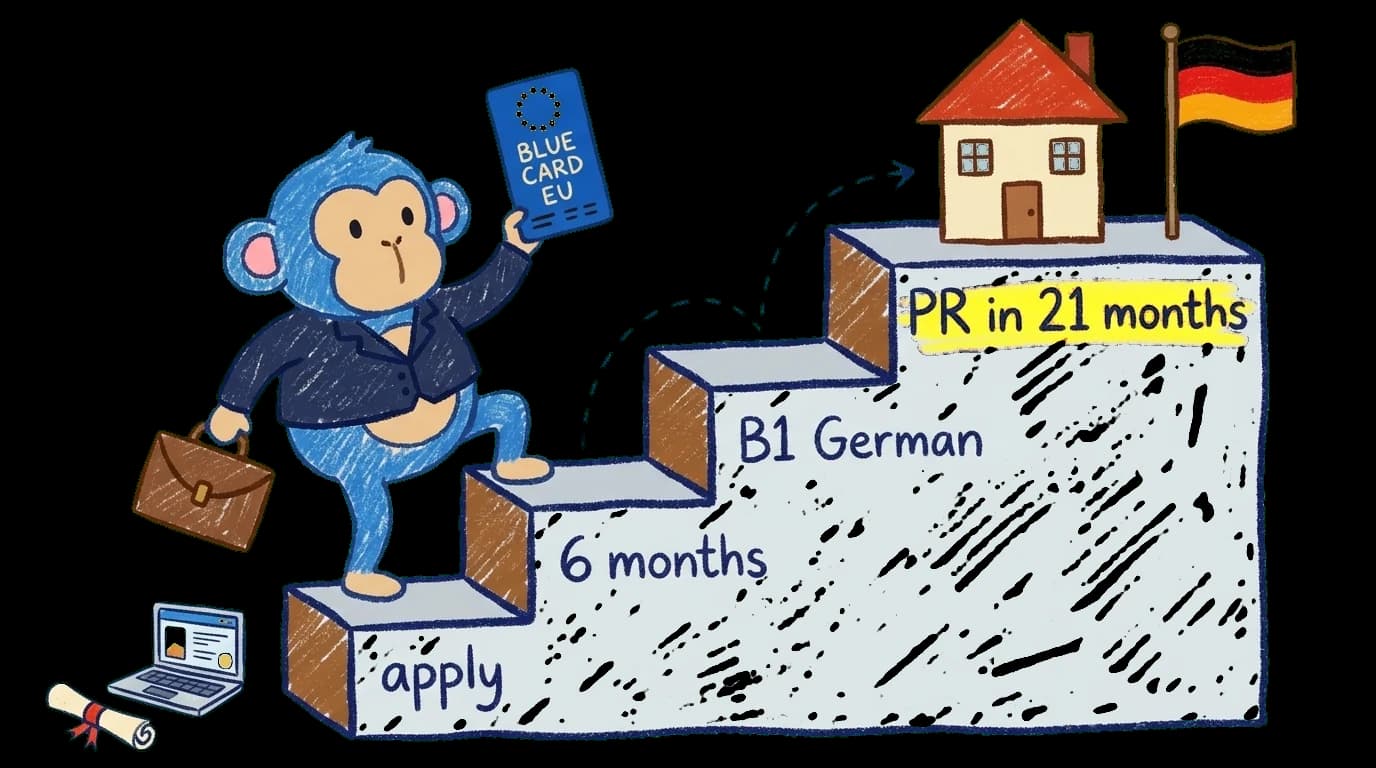
The EU Blue Card offers the fastest path to permanent residency (Niederlassungserlaubnis) in Germany. Your timeline depends on your German language skills:
- 21 months with B1 German language certificate
- 27 months with A1 German language certificate
Compare this to the standard route: regular work permit holders must wait at least 48 months (4 years) for permanent residency, and even then need B1 German. Blue Card holders with just basic A1 German can get PR faster than anyone else.
Requirements for PR via Blue Card
- Held a Blue Card for at least 21 or 27 months continuously
- Paid into the German pension system for the same period
- German language proficiency (B1 for 21-month track, A1 for 27-month track)
- No criminal record
- Adequate living space
- Basic knowledge of German legal and social system (integration course or Life in Germany test)
Path to EU Long-Term Residence
After holding a Blue Card in any EU country for 5 years (with at least 2 years in your current EU country), you can also apply for an EU Long-Term Residence Permit, which gives you the right to live and work in any EU member state.
Family reunification
One of the strongest advantages of the EU Blue Card is its generous family reunification policy:
- Spouse/partner: Can join you in Germany immediately. No German language requirement for the spouse (unlike regular work permits, where the spouse needs A1 German before entry).
- Children: Minor children (under 18) can accompany you or join you later.
- Work rights: Your spouse receives an unrestricted work permit automatically. They can work in any job, full-time or part-time, without a separate work permit application.
Practical Considerations
Your family members will receive a residence permit linked to your Blue Card status. You need to demonstrate adequate living space (roughly 12 sqm per person) and sufficient income to support your family, which is typically met by the Blue Card salary threshold itself.
Family members can also apply for permanent residency after the same 21-27 month period, provided they meet the language requirements independently.
EU mobility and job flexibility
The EU Blue Card is not just a German work permit; it's a gateway to the entire European Union.
Changing Jobs in Germany
- First 12 months: You need approval from the Federal Employment Agency (Bundesagentur fur Arbeit) to change employers. The new job must still meet Blue Card requirements.
- After 12 months: You can change jobs freely without any approval, as long as the new position still qualifies for the Blue Card (salary threshold and qualification match).
Moving Within the EU
After 12 months with a Blue Card in Germany, you can apply for a Blue Card in another EU member state with a simplified process. After 5 years in the EU (with at least 2 in one country), you become eligible for EU Long-Term Residence status.
Short-Term Business Travel
Blue Card holders can travel to other EU/Schengen countries for business purposes for up to 90 days within any 180-day period without additional permits.
What Happens If You Lose Your Job?
You have 3 months to find a new qualifying position before your Blue Card status is affected. During this period, your residence permit remains valid. Register as a job seeker with the Federal Employment Agency immediately to protect your rights.
Frequently asked questions
Ready to apply for the EU Blue Card?
Our experts can help you verify your eligibility, prepare documents, and navigate the application process.