Finding housing in Germany
From student dorms to shared apartments, here is your complete guide to the German housing market, including where to search, what to expect, and how to protect yourself as a tenant.
Last updated: May 2026
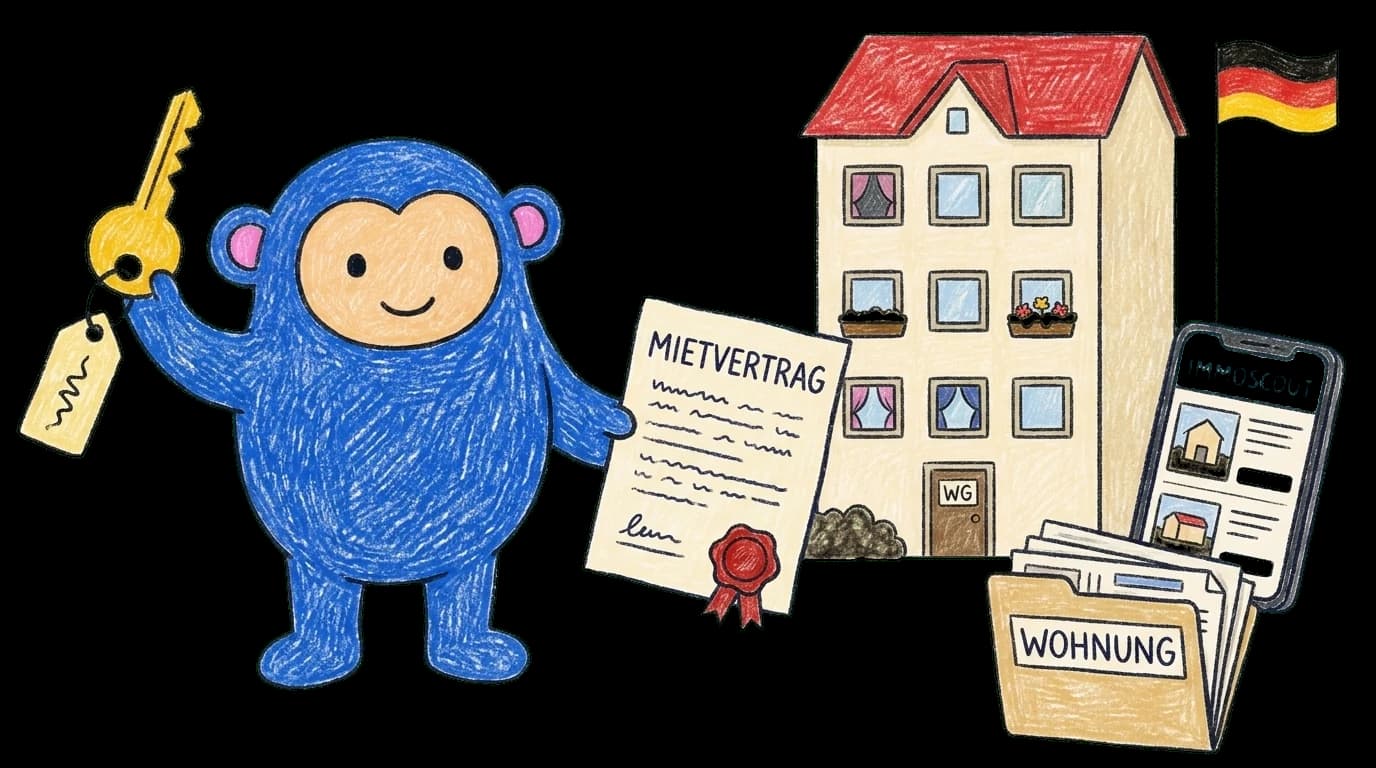
Types of housing
WG (Wohngemeinschaft / Shared Apartment)
The most popular option for students and young professionals. A WG is a shared apartment where each person has a private room and shares the kitchen, bathroom, and living areas.
- Cost: €300-500/month in smaller cities, €450-700 in Berlin, €550-800+ in Munich
- Advantages: Affordable, social (great for meeting people), easier to find than solo apartments, often furnished rooms
- How it works: One person holds the main lease (Hauptmieter) and sublets rooms, or all roommates are on the lease (each as Hauptmieter). Prefer the latter for legal protection
- Finding one: WG-Gesucht.de is the dominant platform. Expect to write 20-50 messages and attend 5-10 "casting" meetings before finding a room
Studentenwohnheim (Student Dormitory)
Dorms run by the local Studierendenwerk (student services organization) are the most affordable option:
- Cost: €200-400/month (includes utilities and often internet)
- Application: Apply through your city's Studierendenwerk website. Waitlists can be 1-3 semesters long
- Types: Single rooms with shared kitchen/bathroom, single apartments (more expensive), or double rooms
- Tip: Apply as soon as you receive your university admission. Do not wait until you arrive
Solo Apartment (Eigene Wohnung)
Renting your own apartment is more expensive and harder to secure, especially without a German credit history:
- Cost: €500-800/month (1-bedroom) in mid-sized cities, €700-1,200+ in Munich/Frankfurt
- Requirements: Landlords typically want Schufa report, proof of income (3x rent), last 3 salary slips, and a Mietschuldenfreiheitsbescheinigung (confirmation that you have no rental debt from previous landlord)
- Competition: In hot markets (Munich, Berlin, Frankfurt), expect 50-100+ applicants per apartment. Viewings are often group events (Massenbesichtigung) with 20-30 people
Temporary / Short-Term Housing
For your first weeks while apartment hunting:
- Hostels: €15-30/night in dorm rooms
- Airbnb / Wunderflats: Furnished short-term apartments, €600-1,200/month
- University guesthouses: Some universities offer temporary rooms for new international students
Where to search
Online Platforms
WG-Gesucht.de (best for WG rooms)
- Germany's largest platform for shared apartments
- Free to use, but a premium account (€15-30/month) lets you see when your messages are read and gives you priority in search results
- Write personalized messages in German (even if basic). Generic copy-paste messages are ignored
- Include: your name, age, what you study/do, when you want to move in, a brief intro about yourself, why you would be a good roommate
Immoscout24.de (best for solo apartments)
- Germany's largest real estate portal with both rental and purchase listings
- ImmobilienScout24 Plus (€30/month) gives you a Schufa credit check and priority notifications for new listings
- Create a search profile and enable email alerts for new listings matching your criteria
Other Platforms
- Kleinanzeigen (formerly eBay Kleinanzeigen): Classifieds with housing section. Watch out for scams
- Studierendenwerk: Your university's student services for dorm applications
- Facebook Groups: "WG [City Name]" and "[City] Housing/Apartments" groups are active. Exercise caution with deposits sent before signing a contract
- Wunderflats: Furnished apartments for 1-24 months, popular with expats
- HousingAnywhere: International student housing platform
Avoiding Scams
- Never pay before viewing: If someone asks for a deposit or first month's rent before you see the apartment (even via photos or video call), it is almost certainly a scam
- Verify the landlord: Ask for their ID and proof of property ownership
- Meet in person: Always visit the apartment before signing anything
- No Western Union / crypto payments: Legitimate landlords accept bank transfers
- Red flags: Rent far below market rate, landlord "abroad" and cannot show the apartment, pressure to pay immediately
Rent, deposit & costs
Understanding German Rent
Kaltmiete (Cold Rent): The base rent for the apartment, before utilities. This is the figure most commonly quoted in listings.
Warmmiete (Warm Rent): Cold rent + Nebenkosten (additional costs), which include heating, water, building maintenance, waste collection, and sometimes internet. Warmmiete is your actual monthly cost.
Nebenkosten: Typically €80-200/month on top of the Kaltmiete, depending on apartment size and heating type.
Electricity: Usually NOT included in Nebenkosten. You sign a separate contract with an electricity provider (Stadtwerke, Vattenfall, E.ON). Budget €30-60/month for a single person.
Kaution (Security Deposit)
- Maximum: 3 months of Kaltmiete (by law, a landlord cannot charge more)
- Can be paid in 3 installments: You can legally pay the deposit in 3 equal monthly installments starting from the first month
- Must be held in a separate account: The landlord must keep your deposit in a special interest-bearing escrow account (Kautionskonto), not in their personal account
- Returned after move-out: Within a "reasonable period" (typically 3-6 months) after you move out, minus any deductions for damages beyond normal wear and tear
Average Rents by City (WG Room, 2026)
| City | WG Room | 1-Bedroom Apartment |
|---|---|---|
| Munich | €600-800 | €900-1,300 |
| Frankfurt | €500-700 | €800-1,100 |
| Berlin | €500-650 | €700-1,000 |
| Hamburg | €450-600 | €700-950 |
| Stuttgart | €450-600 | €700-1,000 |
| Cologne | €400-550 | €650-900 |
| Dusseldorf | €400-550 | €650-900 |
| Aachen | €300-450 | €500-700 |
| Dresden | €280-400 | €450-650 |
| Heidelberg | €400-550 | €650-900 |
Schufa & required documents
What Is Schufa?
Schufa (Schutzgemeinschaft fur allgemeine Kreditsicherung) is Germany's credit scoring agency. Landlords use your Schufa report to verify your financial reliability. A good Schufa score (above 90%) signals that you pay bills on time and have no outstanding debts.
Getting Your Schufa Report
- Free report: You are entitled to one free Datenkopie (data copy) per year from meineschufa.de. This is a detailed report for your own records, but landlords may not accept it because it shows too much personal financial detail
- Schufa-BonitatsAuskunft: The landlord-friendly version costs €29.95 from meineschufa.de. It shows only a summary score and confirmation that there are no negative entries. This is what landlords expect
- Via ImmobilienScout24 Plus: The premium subscription includes a Schufa report (costs €30/month but includes other housing search benefits)
- New to Germany? If you have no Schufa history (common for newcomers), your report will simply show "no entries." This is neutral, not negative. Some landlords accept this; others may ask for additional financial guarantees
Documents Landlords Want
- Schufa-BonitatsAuskunft (credit report)
- Last 3 salary slips (Gehaltsabrechnungen) or scholarship/blocked account confirmation
- Copy of ID/passport
- Mietschuldenfreiheitsbescheinigung: A letter from your previous landlord confirming you have no rental debt. If this is your first rental in Germany, a short explanation letter suffices
- Self-disclosure form (Mieterselbstauskunft): A standard form asking about your income, employment, pets, smoking, and number of people moving in. Landlords provide this or you can find templates online
Tips for Newcomers Without Schufa
- Offer to pay 2-3 months rent upfront (in addition to the Kaution)
- Provide a letter from your employer confirming your salary
- Have a Buerge (guarantor) who is a German resident
- Apply for WG rooms first, as individual roommates tend to be less strict about Schufa than professional landlords
Tenant rights in Germany
Germany has some of the strongest tenant protection laws in Europe. Understanding your rights can save you significant money and stress.
Key Tenant Protections
- Rent control (Mietpreisbremse): In designated areas (most major cities), rent for existing apartments cannot exceed the local reference rent (Mietspiegel) by more than 10%. New buildings and comprehensive renovations are exempt
- Rent increase limits: Your landlord can only increase rent to match the local reference rent, and not by more than 20% within 3 years (15% in some cities). Increases require written notice and your consent
- Notice period: The standard notice period for tenants is 3 months (to the end of a calendar month). Landlords must give 3-9 months notice depending on how long you have lived there, and can only terminate for specific legal reasons
- Protection from eviction: Landlords cannot evict tenants without a court order. Even non-payment of rent requires a formal legal process. Germany heavily favors tenants in disputes
- Maintenance responsibility: Major repairs (heating, plumbing, structural) are the landlord's responsibility. Minor repairs (Kleinreparaturklausel) up to €75-100 per incident may be the tenant's responsibility if specified in the contract
Wohnungsgeberbestatigung
Your landlord is legally required to provide a Wohnungsgeberbestatigung (landlord confirmation of residence) within 14 days of your move-in. You need this for Anmeldung. If your landlord refuses, they face fines up to €1,000. It is a simple one-page form confirming your name, move-in date, and address.
Move-Out Protocol (Ubergabeprotokoll)
- When moving in AND out, do a thorough walkthrough with the landlord and document everything in an Ubergabeprotokoll (handover report)
- Take photos of all rooms, walls, floors, appliances, and any existing damage
- Both parties sign the protocol. This protects you from being charged for pre-existing damage
- Read the Renovierungsklausel (renovation clause) in your contract. Some require you to repaint walls when moving out (in neutral colors), but courts have ruled many of these clauses invalid if they are too rigid
Mieterverein (Tenant Association)
For €50-100/year, a Mieterverein membership gives you legal advice, contract reviews, and representation in disputes with your landlord. Well worth it if you have any concerns about your rental situation.
Practical tips for your search
Strategy for Success
- Start early: Begin searching 2-3 months before your move-in date
- Be flexible on location: Consider neighborhoods outside the city center. With the Deutschlandticket (€63/month), commuting via public transit is affordable
- Write personal messages: Especially on WG-Gesucht, write individual messages to each listing. Mention specific details from the listing. Include a brief introduction about yourself, what you study or do, and why you are interested in that specific WG or apartment
- Learn basic German: Even a message in basic German shows effort and increases your response rate significantly
- Prepare your Bewerbungsmappe: Have all your documents (Schufa, salary slips, ID copy, references) ready in a neat folder. Bring it to every viewing
- Follow up: After a viewing, send a brief thank-you message expressing your interest
What to Check During a Viewing
- Water pressure (turn on the shower)
- Heating system (central heating, gas, or electric?)
- Internet speed (ask current tenants or check with the provider)
- Noise levels (road traffic, neighbors, construction nearby)
- Sunlight and window orientation
- Mold (check corners, bathroom ceiling, window frames)
- Nearest supermarket, public transit stop, and laundry facilities
- Cellar storage (Keller) space, if included
WG Casting Tips
WG "castings" are informal interviews where existing roommates meet potential new members. Think of it as a compatibility check, not a job interview:
- Be yourself. Roommates want to live with someone they like, not someone performing
- Bring a small gift (a cake, snacks) as a nice gesture, though not required
- Ask questions about the WG culture: cleaning schedule, guests policy, noise tolerance, cooking habits
- If you do not hear back within a few days, the room likely went to someone else. Do not take it personally and keep searching
Frequently asked questions
Need help finding housing?
Our accommodation service helps you find and secure housing in Germany before you arrive.